Trust is demonstrated through relevant evidence, transparent scope, reliable process, and clear ownership.
Framer-specific skill matters, but it must be combined with messaging, SEO, conversion, and operational understanding.
Verify what the agency actually completed in every portfolio example.
Ask how URLs, redirects, analytics, forms, and CMS content will be handled.
Ensure your ownership rights and post-launch responsibilities are written into the agreement.
Normalize proposals before comparing price.
A trusted Framer agency should be able to explain not only what it can design, but how it will protect your business during planning, development, migration, launch, and handoff.
Beautiful portfolio images are useful. They are not sufficient evidence that an agency can clarify your offer, structure a CMS, preserve existing search visibility, connect forms, manage responsive behavior, or leave your team with a maintainable website.
Use the following framework to compare agencies on evidence and project fit rather than confidence alone.
What Makes a Framer Agency Trustworthy?
Trust is not one badge or testimonial. It is the combined confidence that an agency can make good decisions, perform the agreed work, communicate risks, and leave the client in control.
A useful evidence ladder is:
Claims: Statements about expertise with no supporting detail
Process evidence: Clear descriptions of how work is completed
Work samples: Relevant pages, systems, or interactions
Attributed feedback: Verifiable testimonials from identifiable clients
Case evidence: Documented situation, work, and supported outcome
Operational proof: Contracts, milestones, ownership terms, documentation, and handoff procedures
No agency will have perfect evidence for every project type. The key is whether its proof is relevant and whether it is honest about limitations.
Framer Expertise Is Necessary, but Not Sufficient
A specialist should understand:
Components and reusable styles
Responsive breakpoints
CMS collections and relationships
Forms and third-party integrations
Metadata, canonical settings, redirects, and sitemap behavior
Accessibility basics
Performance implications of media, scripts, and interactions
Collaboration and handoff workflows
However, platform fluency does not automatically create an effective service-business website. The agency must also understand positioning, buyer questions, service-page content, trust signals, and conversion paths.
Where to Find Framer Agencies
The Framer Experts directory is a logical starting point. It contains freelancers and agencies offering Framer services at different project levels.
Directories can help you create a shortlist. They do not make the final decision for you. Review the agency’s own work, ask for relevant examples, and evaluate the proposed process.
You may also discover agencies through search results, referrals, professional networks, and the credits on Framer websites you admire. Regardless of source, use the same evaluation criteria.
The Trusted Framer Agency Scorecard

A detailed infographic outlining the essential steps involved in the Framer website handoff documentation process, emphasizing clarity and organization.
Score each category from 1 to 5, then multiply it by the suggested weight.
Category | Weight | What strong evidence looks like |
|---|---|---|
Strategic fit | 20% | Connects site decisions to audience, offer, and business goals |
Relevant work | 15% | Shows projects with similar requirements, not merely similar aesthetics |
Framer development | 15% | Explains components, CMS, responsive work, integrations, and QA |
SEO and migration | 15% | Audits URLs, preserves content, maps redirects, and monitors launch |
Process and communication | 10% | Defines milestones, feedback rounds, dependencies, and owners |
Scope transparency | 10% | Lists pages, deliverables, exclusions, and content responsibilities |
Ownership and handoff | 10% | Transfers agreed access and provides usable documentation |
Ongoing support | 5% | Defines warranty, maintenance, or growth options without lock-in |
Adjust the weights to your project. A migration-heavy redesign may give SEO and migration a 25 percent weight. A new campaign microsite may prioritize speed and development execution.
Questions to Ask About Portfolio Work
For each relevant example, ask:
What did your team personally complete?
Was the strategy or copy supplied by another partner?
Did you build the CMS and integrations?
Was this a new site or a migration?
What constraints shaped the solution?
Can you show the live responsive behavior?
Who maintains the website now?
Are any stated results supported by analytics the agency is authorized to share?
This prevents a common misunderstanding in which an agency displays a project but completed only one limited part of it.
Evaluate the Agency’s Discovery Process
A trustworthy agency should ask questions before prescribing a solution.
Useful discovery topics include:
Business model and priority services
Ideal customer and qualification criteria
Current traffic and lead sources
Existing website problems
Competitive alternatives
Required pages and content
Integrations and internal workflows
Compliance requirements
Available evidence and brand assets
Launch constraints and decision-makers
Be cautious if the agency recommends an exact page count, platform setup, or timeline before understanding these requirements.
SEO and Migration Questions
If an existing website has indexed pages, backlinks, or organic traffic, ask the agency to explain its migration procedure.
A credible answer should cover:
Crawling or inventorying current URLs
Reviewing traffic, rankings, and backlinks where data is available
Deciding which content to retain, improve, consolidate, or remove
Mapping old URLs to relevant new destinations
Preserving or improving metadata and page hierarchy
Testing internal links and redirects
Submitting and checking the new sitemap
Monitoring indexing and errors after launch
A promise that “Framer is good for SEO” is not a migration plan. The platform can support strong foundations, but implementation decisions still matter.
For a broader platform comparison, read Framer SEO vs WordPress.
CMS and Content Questions

A sophisticated layout capturing the Pagespeed insights for Framer sites, indicating the high performance levels achievable with effective design.
Ask the agency to show how your actual content will be modeled.
For example, a contractor may need collections for projects, service areas, team members, and articles. A consultant may need insights, speaking engagements, and resources. A B2B business may need solutions, integrations, and case studies.
Clarify:
Which content will use CMS collections?
What fields will editors see?
Can non-technical staff create new entries safely?
Who imports existing content?
How are reusable calls to action managed?
Are collection limits appropriate for expected growth?
What training is included?
The best system is not the most elaborate one. It is the simplest system that supports consistent publishing.
Ownership and Access
Put ownership expectations in writing before the project starts.
Confirm who controls:
Domain registration
DNS
Framer workspace and project
Analytics
Search Console
Form destinations
Third-party integrations
Fonts and licensed assets
Copy and image rights
Design source files, where applicable
Also confirm whether the agency can retain access for support and how that access can be removed.
Compare Proposals on Equivalent Scope
Two quotes may look similar while covering different work.
Proposal item | Agency A | Agency B | Agency C |
|---|---|---|---|
Strategy workshop | Included | Not stated | Separate fee |
Copywriting | Full copy | Client supplied | Editing only |
Unique page designs | 8 | 5 | Not stated |
CMS collections | 3 | 1 | 3 |
Redirect mapping | Included | Excluded | Included |
Analytics setup | Included | Client task | Included |
Training | Recorded handoff | One call | Not stated |
Post-launch support | 30 days | None | Retainer required |
Do not compare totals until every blank has been clarified.
The website redesign cost guide explains other scope variables that can affect proposals.
Red Flags to Take Seriously
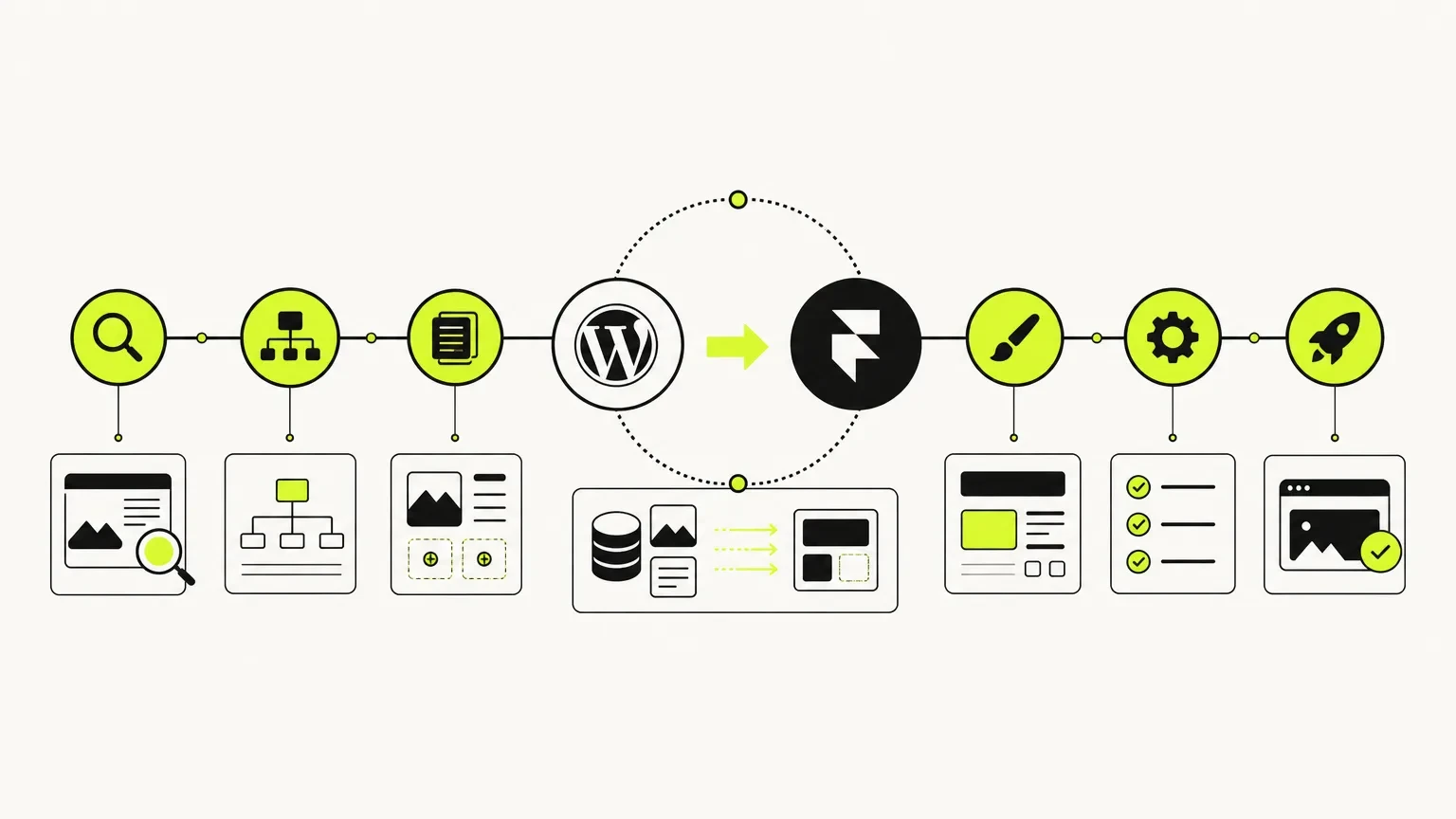
An illustrative timeline depicting the critical steps involved in migrating from WordPress to Framer, ensuring a smooth transition.
Pause before hiring if an agency:
Guarantees rankings or a specific revenue increase without evidence and conditions
Refuses to clarify ownership
Cannot explain how forms and analytics will be tested
Treats mobile design as automatic
Recommends deleting old pages without reviewing their value
Uses inaccessible animations or effects despite concerns
Cannot define who supplies and approves content
Avoids documenting the scope
Pressures you to sign before answering operational questions
Shows only static screenshots and cannot discuss the underlying system
A single unclear answer may be fixable. A pattern of ambiguity is a risk.
Should You Hire a Freelancer or an Agency?
Option | Potential strength | Potential limitation |
|---|---|---|
Freelancer | Direct communication and focused expertise | Capacity may depend on one person |
Small specialist agency | Integrated strategy, design, and development | May have a narrower service range |
Large agency | Broader team and operational capacity | More handoffs and potentially higher overhead |
In-house specialist | Deep company context and ongoing availability | Recruitment cost and narrower outside perspective |
Choose based on project complexity, communication preference, required disciplines, and support needs rather than label alone.
What a Strong Handoff Looks Like
A completed Framer website should not remain mysterious to the client.
A practical handoff may include:
Confirmed account ownership and access
CMS editing instructions
Guidance for adding pages or entries
Component usage rules
Form and integration documentation
Analytics access
Redirect record
Known limitations
Backup or recovery guidance where applicable
Support contact and warranty terms
For ongoing work, distinguish between optional growth support and access that is required merely to keep the site operating.
How We Approach Framer Projects
At Frummerin Digital, we position Framer work around strategy, conversion clarity, performance, SEO foundations, and a maintainable system for service businesses. We use “we” because design and development decisions are treated as parts of the same business system, not isolated visual tasks.
You can review our Framer website design agency service and our more technical Framer website development service when comparing potential approaches.
Conclusion
A trusted Framer agency earns confidence through relevant evidence, transparent scope, sound technical decisions, realistic claims, documented ownership, and a dependable handoff.
Create a shortlist, ask every agency the same questions, normalize the proposals, and score the answers according to your project’s risks. The best partner is not automatically the agency with the most dramatic homepage. It is the one most capable of building and supporting the website your business actually needs.