Framer and WordPress can both rank well on Google when built correctly
Framer is often the better choice for modern service businesses because of cleaner performance, simpler maintenance, and stronger Core Web Vitals
WordPress still performs best for massive blogs, WooCommerce stores, and highly custom systems
Many WordPress websites struggle over time because of plugin bloat, slow performance, and technical debt
Modern SEO in 2026 is about much more than plugins and metadata — speed, structure, UX, crawlability, and content clarity now matter heavily
Framer makes modern SEO foundations easier to achieve for startups, agencies, consultants, and service businesses
Framer SEO vs WordPress: Which Platform Is Better for SEO in 2026?
If you are planning a new website in 2026, there is a good chance you have already asked this question:
Should I use Framer or WordPress for SEO?
For years, WordPress dominated the SEO conversation. It powered blogs, company websites, publishers, and online stores across the internet.
But modern website platforms have changed quickly.
Today, Framer has become one of the fastest-growing website platforms for:
startups
agencies
consultants
SaaS companies
modern service businesses
And one of the biggest reasons is SEO.
Short answer:
Framer is usually the better SEO choice for modern service businesses and marketing websites because it offers:
faster performance
cleaner website structures
lower maintenance
stronger Core Web Vitals
modern design workflows
WordPress still performs better for:
massive blogs
WooCommerce stores
advanced editorial systems
highly custom websites
The key is understanding which platform actually fits your business goals long term.
Businesses planning modern website redesigns should also think carefully about long-term scalability and maintenance before choosing a platform. Read more about that here:
https://frummerin-digital.com/blog/website-redesign-cost
What Actually Matters for SEO in 2026
A lot of older SEO advice still focuses heavily on:
plugins
metadata
keyword density
technical settings
Those things still matter.
But SEO has changed significantly.
Modern SEO now heavily rewards:
fast websites
clean content hierarchy
strong mobile UX
semantic structure
crawl efficiency
strong Core Web Vitals
content clarity
topical authority
user engagement
fast render performance
This is becoming even more important because of:
AI Overviews
ChatGPT
Perplexity
Gemini
conversational AI search
In other words:
Modern SEO is no longer just about adding more plugins.
It is about building websites that are:
easy to crawl
easy to understand
fast to load
easy to navigate
easy to maintain
That is where the Framer vs WordPress conversation becomes much more interesting.
Framer SEO vs WordPress: Quick Comparison
Category | Framer | WordPress |
|---|---|---|
Technical SEO | Excellent out of the box | Depends heavily on setup |
Core Web Vitals | Usually strong | Highly variable |
Speed | Fast by default | Often requires optimization |
Maintenance | Very low | Ongoing |
Plugin dependency | Minimal | High |
CMS scalability | Medium to high | Extremely high |
Design workflow | Excellent | Depends on builder |
Security management | Platform managed | User managed |
Crawlability | Usually clean | Depends on setup |
SEO tooling | Simpler | More advanced |
Best for | Modern business websites | Large content ecosystems |
Founder Insight: Why I Moved Away From WordPress
When I first started building websites, almost everything I worked on was built in WordPress.
At the beginning, it made sense. WordPress was flexible, widely used, and had endless plugins available.
But over time, I kept running into the same problems:
slower websites
plugin conflicts
bloated page builders
difficult redesigns
inconsistent editing systems
Eventually, I realized most modern service businesses did not actually need that level of complexity.
That became one of the biggest reasons I gradually moved toward Framer.
A lot of those problems are similar to the issues discussed in this article about the hidden long-term costs of outdated websites:
https://frummerin-digital.com/blog/the-hidden-costs-of-a-cheap-website-why-poor-design-costs-more-long-term
Why Framer Is Becoming So Popular for SEO
Cleaner Technical Foundations
One of Framer’s biggest advantages is simplicity.
Most Framer websites are built with:
fewer dependencies
cleaner frontend structures
lighter code output
modern CDN infrastructure
optimized rendering
simpler content architecture
That matters because SEO problems often come from complexity.
Many WordPress websites slowly become weighed down by:
plugins
page builders
outdated themes
external scripts
animation libraries
tracking conflicts
Over time, this can hurt:
page speed
crawlability
indexing efficiency
mobile UX
Core Web Vitals
render performance
Framer removes much of that complexity from the beginning.
Better Performance Out of the Box
At Frummerin Digital, performance is heavily prioritized during every build.
We regularly use:
Ahrefs
Google Search Console
Lighthouse
PageSpeed Insights
to monitor:
Core Web Vitals
crawl health
indexing
technical SEO
organic visibility
One reason Framer works so well for modern SEO is because strong performance is much easier to achieve without extensive optimization work.
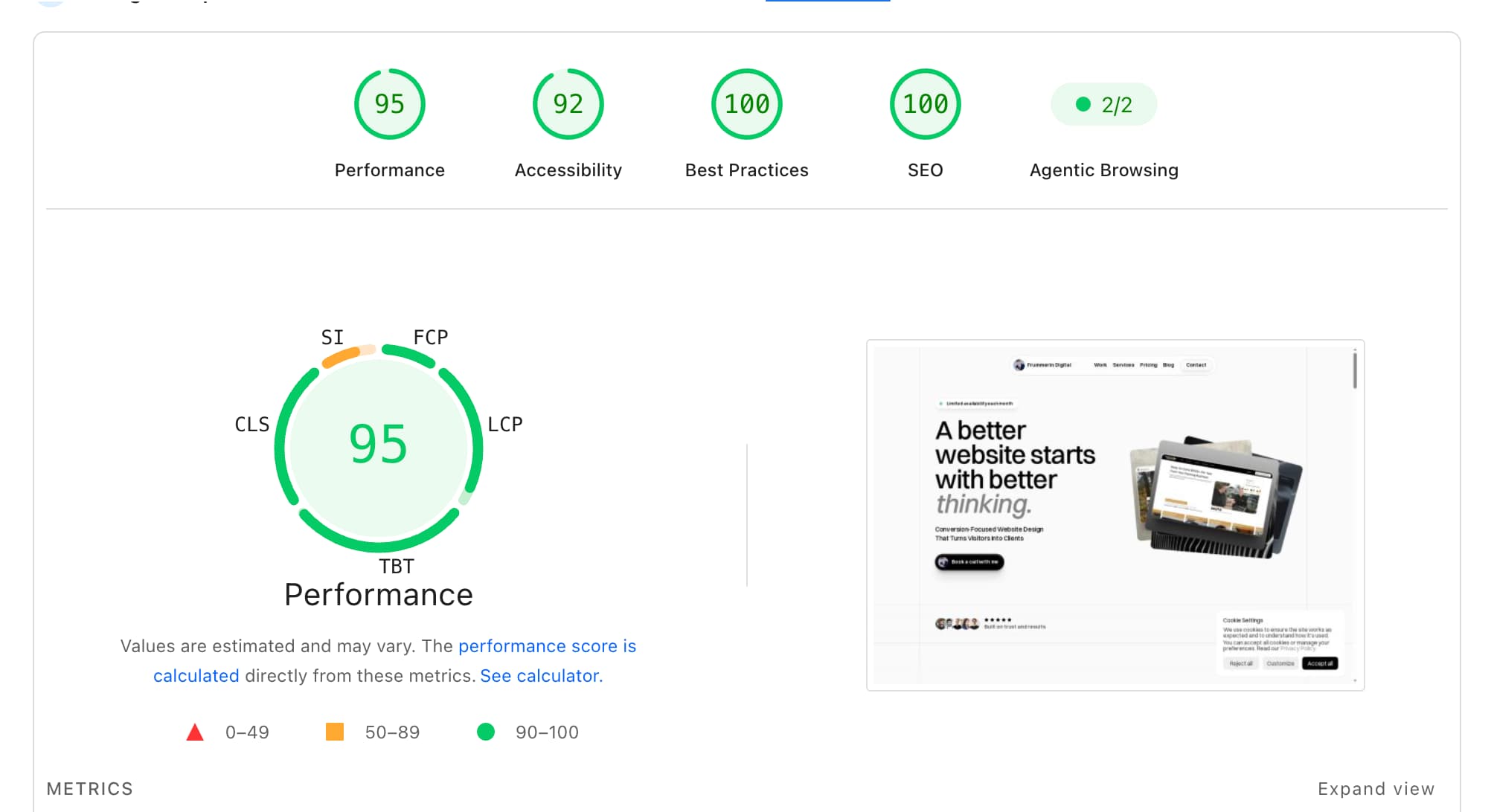
Our own Frummerin Digital website currently achieves:
95 Performance
92 Accessibility
100 Best Practices
100 SEO
on Lighthouse testing.
This does not mean every Framer website automatically performs this well.
But it does show the type of performance modern Framer websites can achieve with a clean, performance-focused build.
Why This Matters for SEO
Google increasingly rewards websites that:
load quickly
respond smoothly
maintain layout stability
perform well on mobile devices
Fast websites also tend to:
reduce bounce rates
improve engagement
increase conversions
improve crawl efficiency
For service businesses especially, this matters heavily.
A slower website often means:
fewer enquiries
lower trust
weaker mobile experience
poorer conversion rates
If you want to understand how website structure directly impacts business growth and conversions, this article expands on that further:
https://frummerin-digital.com/blog/how-to-structure-a-service-business-website-for-maximum-growth
Founder Insight: What Immediately Felt Different About Framer
The first thing that stood out to me about Framer was speed.
Not only website speed, but workflow speed.
Designing, editing, publishing, and iterating all felt significantly smoother compared to many traditional WordPress workflows.
Instead of constantly managing plugins or troubleshooting layouts, more time could be spent improving:
UX
SEO structure
conversion flow
messaging
content systems
That completely changed how I approached modern website projects.
Why Many WordPress Websites Struggle With SEO Over Time
This is something many businesses discover too late.
WordPress itself is not bad for SEO.
In fact, WordPress can be extremely powerful.
The problem is usually what happens over time.
Plugin Bloat
Many WordPress websites slowly accumulate:
SEO plugins
caching plugins
security plugins
popup plugins
animation plugins
builder plugins
optimization plugins
Eventually, websites become harder to:
optimize
redesign
maintain
troubleshoot
Even small updates can sometimes break:
layouts
forms
mobile responsiveness
frontend rendering
Technical Debt
Over time, many WordPress websites become trapped inside older systems.
This creates technical debt.
Businesses often end up stuck with:
outdated themes
Elementor-heavy builds
Divi-based layouts
slow hosting
bloated frontend code
This quietly hurts:
indexing
page speed
crawlability
mobile-first performance
long-term SEO scalability
SEO Plugins Cannot Fix Weak Foundations
This is extremely important.
Many businesses believe:
“If I install Yoast or RankMath, my SEO is handled.”
But SEO plugins do not fix:
poor UX
weak structure
slow performance
poor mobile layouts
weak content
frontend bloat
Plugins help support SEO.
They do not replace strong website foundations.
Why Most Modern Service Businesses Do Not Need WordPress Anymore
This is where the conversation changes.
Most service businesses mainly need websites that:
generate leads
build trust
rank locally
publish content
scale cleanly
convert visitors
Most do not need:
massive plugin ecosystems
advanced publishing systems
complex backend logic
huge editorial workflows
For many businesses, WordPress introduces more complexity than they actually need.
Framer often provides:
cleaner systems
stronger performance
faster launch timelines
easier editing
simpler maintenance
more consistent UX
cleaner mobile responsiveness
This is especially valuable for:
contractors
consultants
agencies
wellness businesses
law firms
home service companies
modern local businesses
Modern conversion-focused website systems are becoming increasingly important for service businesses trying to compete online:
https://frummerin-digital.com/blog/why-your-service-business-website-isn-t-converting-(and-how-to-fix-it)
SEO Traffic Means Nothing If the Website Does Not Convert
Many businesses focus entirely on rankings.
But rankings alone do not grow a business.
A website can generate thousands of visitors every month and still struggle to produce:
calls
enquiries
consultations
booked projects
revenue
This is where website structure becomes extremely important.
Modern SEO and conversion optimization are now deeply connected.
Factors like:
page clarity
trust signals
CTA placement
mobile usability
readability
layout hierarchy
loading speed
navigation
all influence whether visitors actually take action.
This is one reason Framer has become so attractive for many modern service businesses.
The platform makes it easier to create:
visually clean layouts
modern mobile experiences
stronger conversion flows
clearer page structures
without relying heavily on third-party builders.
At Frummerin Digital, SEO is approached as part of a larger website system.
The goal is not simply:
“more traffic.”
The goal is:
attracting the right visitors and turning them into qualified enquiries.
Related reading:
Website structure and growth:
https://frummerin-digital.com/blog/how-to-structure-a-service-business-website-for-maximum-growthWhy many websites lose leads:
https://frummerin-digital.com/blog/why-most-service-business-websites-lose-clients-before-the-first-scrollIntentional website design systems:
https://frummerin-digital.com/blog/the-scandinavian-strategy-how-intentional-web-design-drives-high-conversions-for-service-businesses
Framer CMS vs WordPress CMS
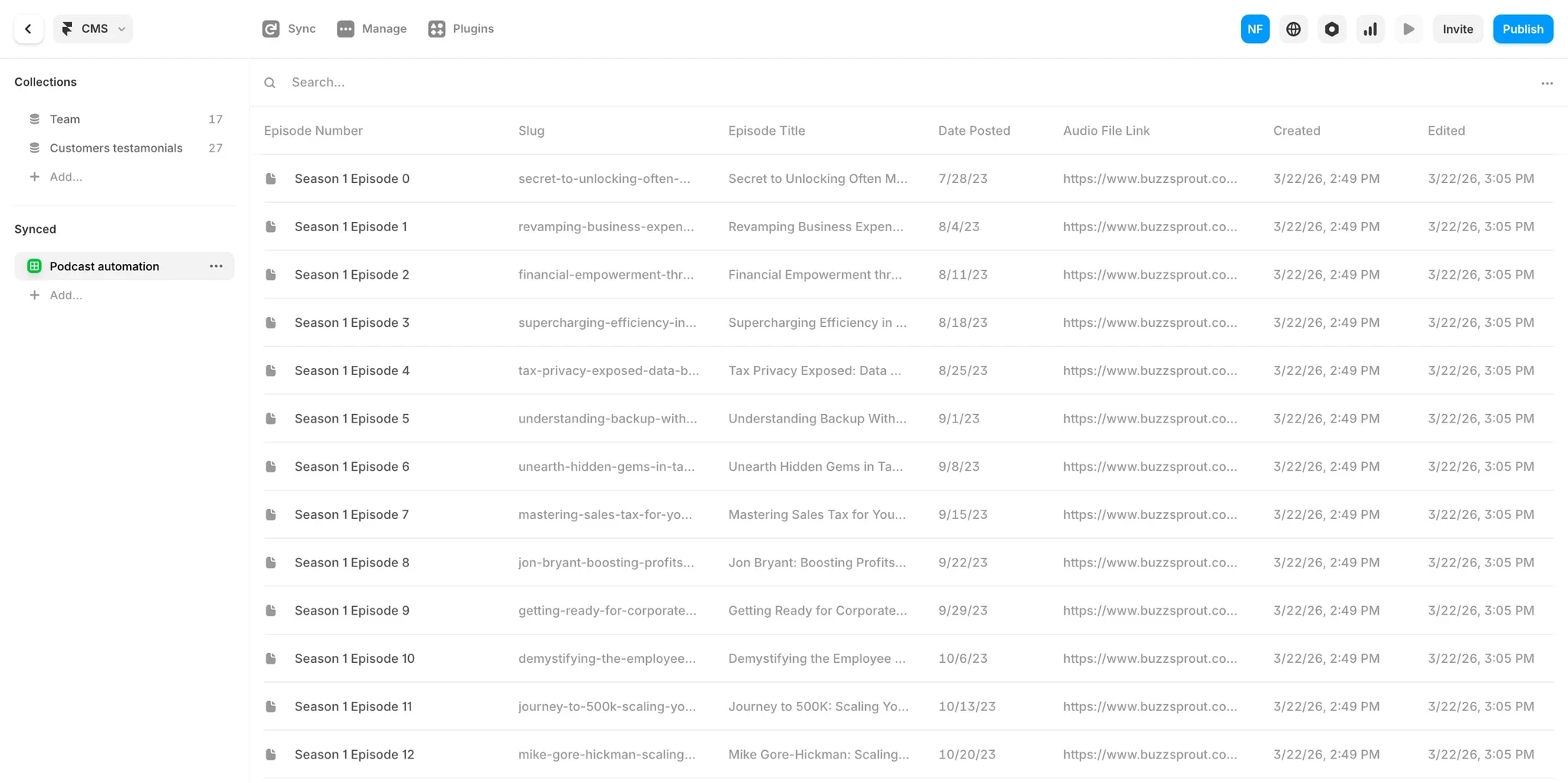
Real Example: Automated Podcast Publishing in Framer
For one client project, Profitable Painter CPA, we built a custom automation using Make.com that automatically syncs podcast episodes directly into the Framer CMS.
Instead of manually uploading every episode, the system automatically updates:
episode titles
publishing dates
CMS entries
podcast content
structured content organization
This creates:
faster publishing workflows
cleaner content systems
more consistent indexing
easier long-term scalability
For businesses publishing regular content, cleaner automation systems like this can significantly reduce operational overhead while keeping websites consistently updated for both users and search engines.
WordPress CMS Strengths
WordPress still dominates when it comes to:
massive blogs
editorial workflows
custom post types
membership systems
WooCommerce
advanced integrations
If your business publishes hundreds or thousands of articles, WordPress still has a major advantage.
Framer CMS Strengths
Framer CMS is significantly cleaner and simpler.
For most businesses, it is more than enough for:
blogs
case studies
services
landing pages
portfolios
team pages
It is also much easier for non-technical teams to manage consistently.
That simplicity often creates better long-term SEO consistency.
Best Platform by Business Type
Business Type | Better Choice |
|---|---|
Local service business | Framer |
Startup or SaaS | Framer |
Marketing website | Framer |
Agency website | Framer |
Portfolio website | Framer |
Large publishing site | WordPress |
WooCommerce store | WordPress |
Membership platform | WordPress |
Multi-author blog | WordPress |
Complex enterprise CMS | WordPress |
Framer SEO Features vs WordPress SEO Features
Framer SEO Features
Framer includes:
sitemap generation
canonical URLs
redirects
meta titles
meta descriptions
Open Graph controls
alt text support
without needing plugins.
This creates a much cleaner SEO workflow.
WordPress SEO Features
WordPress offers deeper SEO customization through plugins like:
Yoast SEO
RankMath
All in One SEO
These tools provide:
schema generation
advanced metadata controls
breadcrumbs
SEO scoring
advanced sitemap settings
For highly advanced SEO workflows, WordPress still provides more flexibility.
Founder Insight: Simpler Systems Usually Scale Better
One thing I have learned from building websites is that simpler systems usually age better.
Many websites do not fail because the original design was bad.
They struggle because over time they become:
harder to edit
harder to optimize
harder to maintain
inconsistent across pages
For many service businesses, a cleaner website system actually creates better long-term SEO performance.
Framer vs WordPress for Core Web Vitals
Core Web Vitals are now one of the most important parts of technical SEO.
This includes:
loading performance
responsiveness
layout stability
Framer websites often perform very well here because:
hosting is modern
rendering is optimized
frontend systems are cleaner
fewer plugins are involved
CDN delivery is built in
WordPress websites can absolutely achieve excellent Core Web Vitals too.
But it usually requires:
stronger hosting
caching systems
optimization plugins
developer oversight
frontend cleanup
For many businesses, Framer simply makes strong performance easier to maintain long term.
Intentional minimal website systems can also improve user experience and conversion clarity:
https://frummerin-digital.com/blog/the-scandinavian-edge-why-less-is-more-in-2026-web-design-for-us-service-businesses
Hidden Long-Term Costs
Problem | Common With WordPress | Common With Framer |
|---|---|---|
Plugin conflicts | High | Very low |
Security maintenance | Ongoing | Minimal |
Builder bloat | Common | Rare |
Hosting management | Required | Managed |
Performance optimization | Often necessary | Usually simpler |
Technical debt over time | High risk | Lower risk |
Redesign complexity | Often high | Usually simpler |
Related reading:
Hidden website costs:
https://frummerin-digital.com/blog/the-hidden-costs-of-a-cheap-website-why-poor-design-costs-more-long-termWebsite redesign strategy:
https://frummerin-digital.com/blog/website-redesign-cost
Why AI Search Changes the Framer vs WordPress Conversation
SEO is changing quickly.
Search engines are increasingly moving toward:
AI-generated answers
semantic search
conversational search
AI Overviews
entity understanding
This changes what websites need to prioritize.
Modern search systems now rely heavily on:
semantic HTML
structured content hierarchy
crawlable architecture
page clarity
topical authority
content relationships
fast render performance
In many ways, cleaner websites now have an advantage.
This is one reason modern Framer websites are becoming increasingly attractive for SEO-focused businesses.
Because Framer websites are often built with:
simpler frontend structures
cleaner systems
reduced plugin dependency
faster performance
modern responsive layouts
they can create cleaner crawlability and stronger user experiences.
This does not mean Framer automatically ranks better.
But modern SEO increasingly rewards the kinds of foundations Framer makes easier to build.
Especially for:
agencies
startups
consultants
SaaS businesses
modern service companies
Framer vs WordPress Maintenance
Framer
Framer handles:
hosting
updates
platform security
infrastructure
publishing systems
This dramatically reduces maintenance overhead.
WordPress
WordPress requires:
plugin updates
theme updates
backups
hosting management
security monitoring
compatibility management
For businesses without technical teams, this often becomes frustrating over time.
Framer vs WordPress Cost
Many businesses assume WordPress is cheaper.
At first, it often is.
But long term, costs can grow through:
premium plugins
hosting upgrades
maintenance
developer fixes
security tools
redesign costs
Framer is usually much more predictable.
For many modern business websites, that simplicity becomes extremely valuable long term.
Founder Insight: SEO Is More Than Plugins
A lot of businesses assume SEO is mostly about installing the right plugin.
But after working on many websites, I have found the opposite is often true.
The strongest SEO foundations usually come from:
clean structure
fast loading speeds
semantic content hierarchy
mobile UX
crawl efficiency
strong internal linking
clear messaging
Plugins can support SEO.
But they cannot fix weak website foundations.
When Framer Is the Better SEO Choice
Choose Framer If:
You run a service business
You want a modern marketing website
You value performance
You want lower maintenance
You care heavily about UX
You want strong Core Web Vitals
You need cleaner systems
You want faster launch timelines
You want easier long-term management
This is especially true for:
contractors
consultants
agencies
wellness businesses
local businesses
startups
SaaS companies
Related reading:
https://frummerin-digital.com/blog/framer-vs.-webflow-which-is-better-for-your-service-business
When WordPress Still Makes More Sense
Choose WordPress If:
You run a massive blog
You need WooCommerce
You need advanced memberships
You need highly custom backend systems
You need deep plugin integrations
You have a large editorial team
Your website behaves more like a publishing platform
WordPress is still one of the most powerful CMS platforms in the world.
It simply is not always the best fit anymore for modern business websites.
Can You Migrate From WordPress to Framer Without Losing SEO?
Yes — but it needs to be handled carefully.
A proper migration should preserve:
URL structure
redirects
metadata
sitemap architecture
internal links
image optimization
semantic hierarchy
Poor migrations can cause:
traffic losses
broken pages
indexing problems
ranking drops
At Frummerin Digital, migrations focus heavily on preserving SEO equity while modernizing the overall website system.
Related reading:
https://frummerin-digital.com/blog/how-to-migrate-wordpress-to-framer-site-checklist
Final Verdict
So, is Framer or WordPress better for SEO in 2026?
The honest answer is:
Both platforms can rank extremely well.
But they solve very different problems.
WordPress remains one of the strongest platforms available for:
large-scale publishing
WooCommerce
advanced integrations
highly custom systems
Framer, however, has become one of the best options for:
modern service businesses
startups
agencies
SaaS companies
conversion-focused marketing websites
especially for teams that want:
cleaner systems
stronger performance
lower maintenance
modern UX
simpler workflows
cleaner long-term scalability
For most modern service businesses, the biggest SEO challenge is no longer adding more plugins or technical settings.
It is building a website that is:
fast
scalable
easy to manage
conversion-focused
technically clean
easy for both users and search engines to understand
That is one reason more businesses are now moving toward cleaner website systems built around long-term simplicity instead of endless plugin stacks.
If you are planning a redesign, migration, or modern SEO-focused website, you can learn more about Frummerin Digital here:
https://frummerin-digital.com/
Or start a conversation here:
https://frummerin-digital.com/let%E2%80%99s-talk