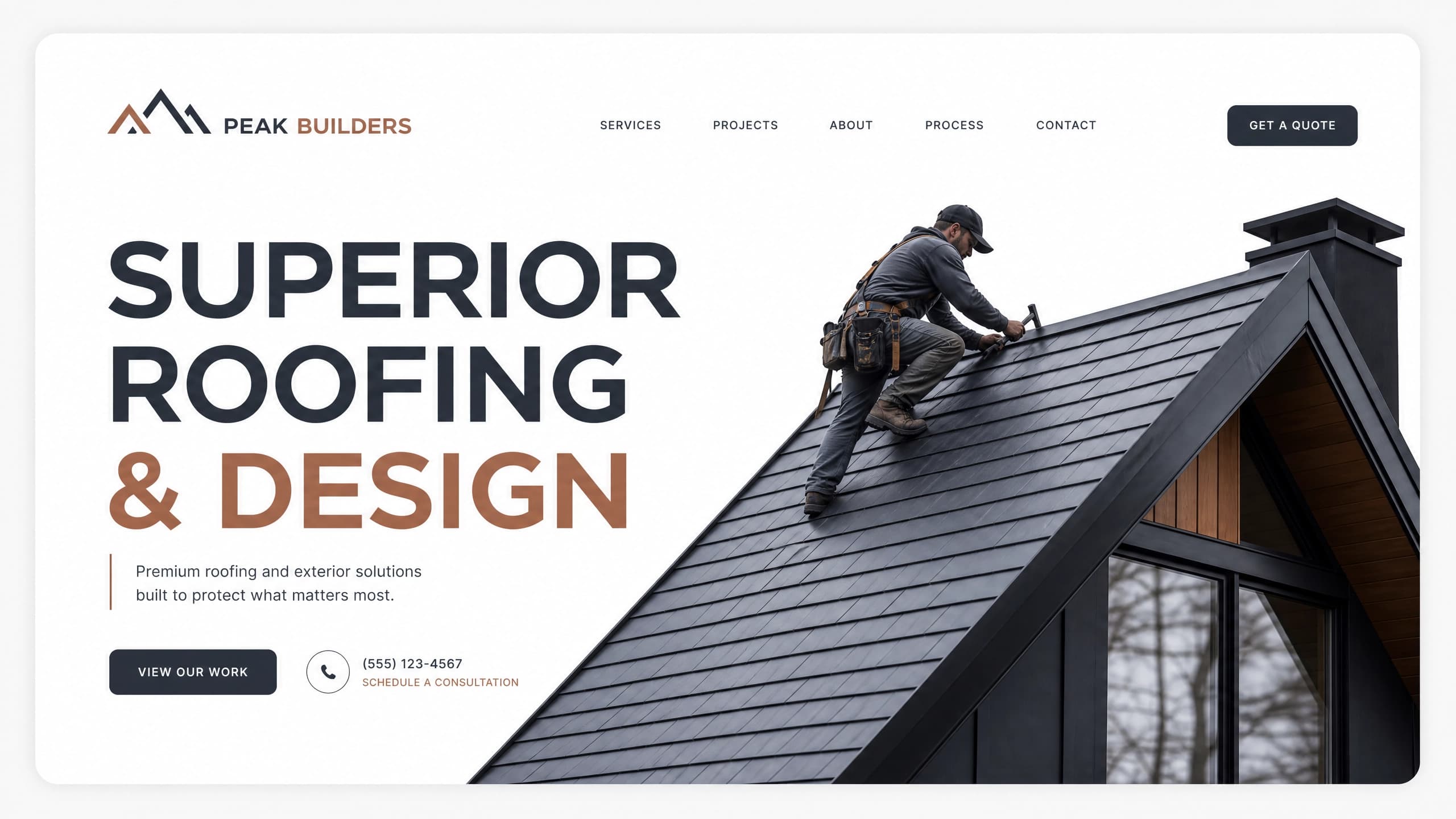

Most contractor websites fail because they lack trust, clarity, SEO structure, and conversion-focused strategy
High-performing contractor websites combine strong branding, local SEO, mobile optimisation, and lead-generation structure
Contractor websites should function as marketing systems, not digital brochures
Dedicated service pages, reviews, project galleries, and fast page speeds significantly improve conversion rates
Modern contractor website design focuses on generating qualified leads, improving credibility, and increasing local visibility
Website Design for Contractors: What Actually Generates More Leads in 2026
Most contractor websites fail long before a visitor ever calls the business.
Not because the contractor is bad at their work.
Not because they lack reviews.
Not because they do not care about quality.
The problem is usually much simpler:
The website does not build enough trust, clarity, or momentum for someone to take action.
For contractors, a website is no longer just an online business card. It has become the first impression, the trust-builder, the estimator pre-qualifier, the portfolio, and often the deciding factor between you and another company.
A modern contractor website should do three things extremely well:
Build immediate trust
Clearly explain what you do
Convert visitors into qualified leads
Most contractor websites only manage one of those.
At Frummerin Digital, we focus on conversion-focused website design for contractors and service businesses that need more than just a “nice-looking website.” The goal is to create a system that helps contractors generate consistent enquiries, improve perception, and scale more effectively online.
Why Most Contractor Websites Underperform
Many contractor websites still rely on outdated structures and generic templates.
Common issues include:
Weak messaging
Slow page speeds
Poor mobile responsiveness
Confusing navigation
Low-quality project imagery
Generic layouts
Missing SEO structure
Weak calls-to-action
Difficult enquiry forms
The result?
Visitors leave before they trust the company enough to contact them.
One of the biggest mistakes contractors make is treating their website like a digital brochure instead of a lead-generation system.
The best contractor websites are intentionally structured around:
Trust
Clarity
Proof
Local authority
Conversion
Not visual clutter.
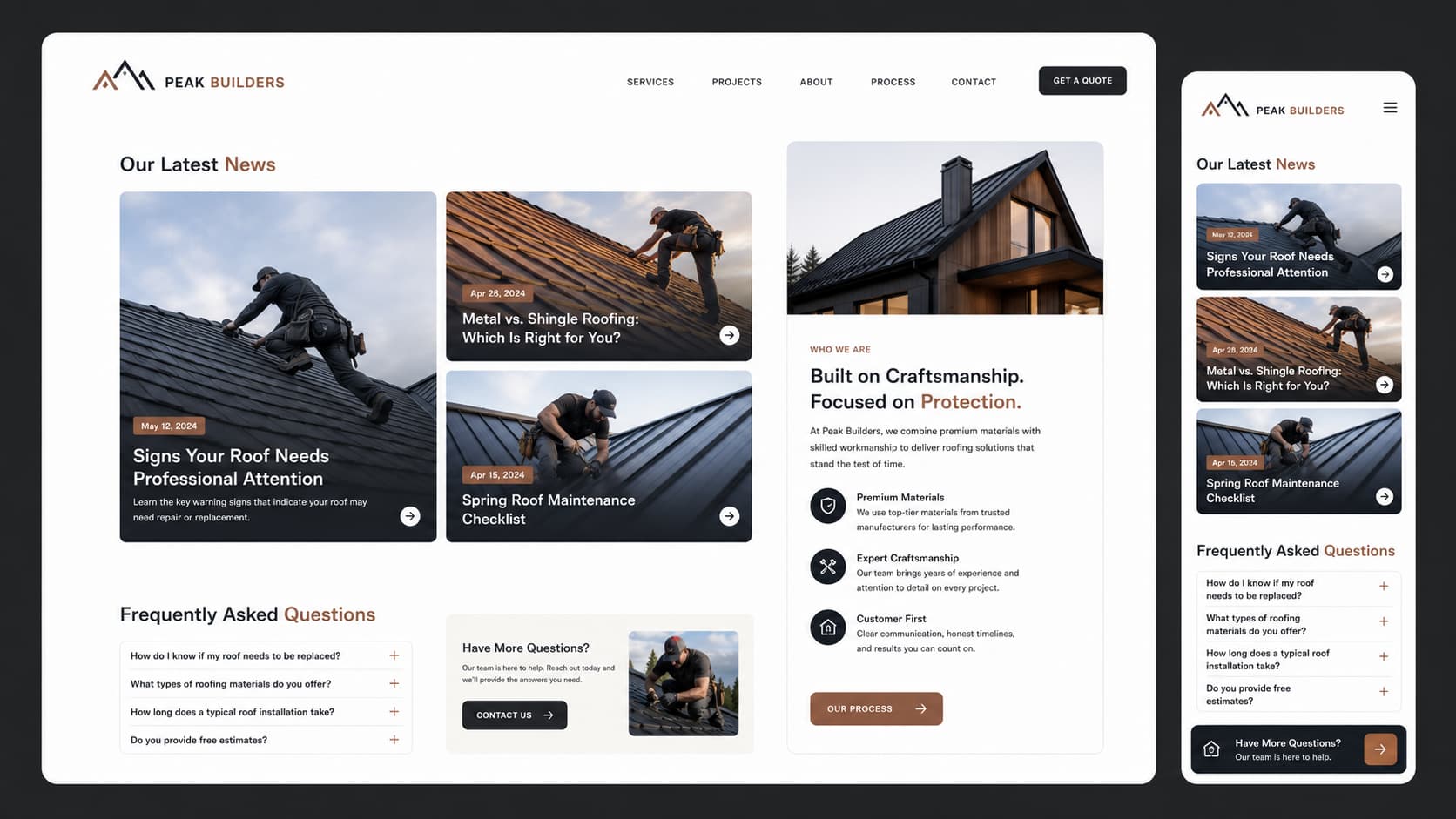
What the Best Contractor Websites Do Differently
They Immediately Explain What the Business Does
Within the first few seconds, visitors should understand:
What services you offer
Where you work
Who you work with
Why you are different
Weak example:
“Building Excellence Since 1998”
Stronger example:
“Custom Kitchen Renovations for Homeowners Across Houston”
Specificity converts.
The best construction company websites avoid vague branding and focus on clarity immediately.
They Use Real Proof Everywhere
The highest-performing contractor websites rely heavily on:
Project photography
Testimonials
Reviews
Before-and-after examples
Case studies
Certifications
Team visibility
Years in business
Trust compounds visually.
This is especially important for roofing contractors, remodelers, painters, HVAC companies, kitchen renovation businesses, and other home service companies where credibility directly impacts lead generation.
They Prioritise Mobile Experience
Most contractor website traffic now comes from mobile devices.
If your website:
Loads slowly
Feels cramped
Uses tiny buttons
Buries contact information
Has poor phone navigation
Uses difficult forms
…you lose leads before conversations even begin.
Responsive contractor website design is no longer optional.
It directly impacts:
SEO rankings
User experience
Conversion rates
Trust perception
They Build Local SEO Into the Structure
Good contractor websites are not just designed visually.
They are structured strategically around search intent.
That means:
Dedicated service pages
City and service combinations
SEO-friendly page hierarchy
Internal linking
Optimised metadata
Structured content
Keyword-focused headings
Image optimisation
Fast-loading pages
Without SEO structure, even visually impressive contractor websites struggle to rank.
Why SEO Matters for Contractor Websites
Many contractors still rely heavily on referrals.
But even referral-based businesses are now strongly influenced by Google search visibility.
When homeowners search for:
“Kitchen remodel contractor near me”
“Roofing company in Houston”
“HVAC contractor”
“Bathroom renovation contractor”
“Concrete contractor near me”
…the companies appearing first often receive the majority of enquiries.
Strong contractor SEO includes:
Local SEO optimisation
Targeted service area pages
Optimised H tags and metadata
Fast page speeds
Mobile optimisation
Google Business Profile integration
XML sitemap setup
Structured internal linking
Keyword research
SEO-focused content strategy
Without these foundations, contractor websites often become invisible online.
What a High-Converting Contractor Website Should Include
The best contractor websites simplify decision-making.
They guide homeowners naturally toward taking action while reducing hesitation throughout the customer journey.
Essential Sections Every Contractor Website Needs
Section | Purpose |
|---|---|
Strong hero section | Communicates value immediately |
Service overview | Explains exactly what you do |
Project showcase | Builds visual trust |
Testimonials & reviews | Reduces hesitation |
Local SEO pages | Improves rankings |
Clear CTA sections | Drives enquiries |
About/team section | Humanises the business |
FAQ section | Removes objections |
Fast contact flow | Makes conversion easy |
Each section should support one core goal:
Moving visitors closer toward contacting your business.
For example:
A strong hero section creates immediate clarity
Reviews and testimonials reduce uncertainty
Project galleries build confidence visually
FAQ sections remove common objections
CTA sections guide users naturally toward enquiry
The highest-performing contractor websites are intentionally structured to create trust at every stage of the experience.
The Most Important Features Every Contractor Website Needs in 2026
Not all contractor websites need advanced functionality.
But the highest-performing contractor websites usually include a consistent set of conversion-focused features.
Feature | Why It Matters |
|---|---|
Mobile-responsive design | Most contractor traffic comes from phones |
Fast page speeds | Slow websites increase bounce rates |
Dedicated service pages | Helps rank for contractor SEO keywords |
Google review integration | Builds immediate trust |
Before-and-after galleries | Demonstrates workmanship visually |
Simple contact forms | Reduces enquiry friction |
Clear CTA sections | Guides visitors toward action |
CMS/blog system | Supports long-term SEO growth |
Local SEO structure | Improves visibility in Google search |
Conversion-focused layouts | Improves lead generation performance |
The goal is not adding unnecessary features.
It is creating a contractor website that removes doubt and makes contacting your business feel easy.
The Biggest Mistake Contractors Make
Many contractors invest in websites that focus entirely on aesthetics.
The issue is that attractive does not automatically mean effective.
A contractor website should function more like a sales system than a digital brochure.
Every section should help answer one of these questions:
Can I trust this company?
Have they done this before?
Do they understand my project?
Are they professional?
What happens next?
If the website fails to answer those questions clearly, conversions drop.
Generic Website Builders vs Strategic Contractor Websites
Many contractors initially use DIY website builders or cheap templates.
While these platforms can work temporarily, they often struggle to support long-term growth.
Generic DIY Website | Strategic Contractor Website |
|---|---|
Template-based layouts | Custom conversion-focused structure |
Weak local SEO | SEO-first architecture |
Generic messaging | Trade-specific positioning |
Minimal trust signals | Reviews and proof integrated throughout |
Slow performance | Optimised loading speeds |
Difficult scaling | Built for long-term growth |
Limited lead strategy | Designed around conversions |
The issue is rarely the platform itself.
The problem is usually the lack of strategy behind the structure.
Why Website Performance Impacts Contractor Lead Generation
Research consistently shows that slower websites produce higher bounce rates and lower conversion rates.
For contractor businesses, even small delays in page speed can reduce:
Phone calls
Form submissions
Mobile engagement
Local SEO visibility
Fast-loading contractor websites improve:
User experience
Search engine rankings
Mobile usability
Conversion rates
Trust perception
Website performance is no longer just a technical issue.
It directly impacts revenue generation.
Contractor Website Design vs Generic Agency Design
Many generic agencies approach contractor websites incorrectly.
They often prioritise:
Excessive animations
Visual effects
Overly creative layouts
Style over clarity
But contractors usually need something else:
Authority
Trust
Clarity
Simplicity
Lead generation
Local visibility
This is why specialised contractor website design tends to outperform generic agency builds.
The structure is intentionally designed around how homeowners actually choose contractors.
Why Website Strategy Matters More Than Just Design
At Frummerin Digital, the philosophy behind every project is simple:
“A better website starts with better thinking.”
That means the process starts with:
Understanding the business
Identifying ideal customers
Clarifying positioning
Mapping conversion flow
Structuring SEO properly
Planning lead generation pathways
The visual design comes after the strategy.
Because even the best-looking contractor website will struggle if:
The messaging is weak
The structure is confusing
The SEO is poor
The trust signals are missing
How Long Does Contractor Website Design Take?
The timeline depends on the size and complexity of the project.
A smaller contractor website may take 2–4 weeks, while larger projects with SEO structures, service pages, and advanced integrations may take significantly longer.
Factors That Affect Contractor Website Timelines
Factor | Impact |
|---|---|
Number of pages | More pages increase build time |
Copywriting requirements | Strategic content takes longer |
SEO implementation | Local SEO structure requires planning |
Project photography | Visual assets improve trust and quality |
CRM or booking integrations | Advanced functionality adds complexity |
Revision rounds | Additional revisions increase timelines |
Service area targeting | More locations require additional pages |
The fastest websites are not always the best-performing ones.
Strong contractor websites require strategic planning and proper structure.
Signs Your Contractor Website Needs a Redesign
You may need a redesign if:
Your website looks outdated
You rarely get organic leads
Visitors leave quickly
Competitors appear more credible online
Mobile experience feels poor
Your services are unclear
Your pages load slowly
Your website feels generic
You are embarrassed to send people to it
Your website is difficult to update
A contractor website should increase confidence — not create doubt.
Contractor Website Design Is Part of a Larger Marketing System
A contractor website should not operate independently from your marketing.
The strongest contractor brands connect their website with:
Google Business Profile
Local SEO
Google Ads
Facebook and Instagram
CRM systems
Email follow-up systems
Lead tracking
Local business directories
Review platforms
When these systems work together, the website becomes a central lead-generation asset rather than a static brochure.
This is one reason modern contractor websites consistently outperform older “set-and-forget” websites.
The Shift Happening in Contractor Marketing
The contractor industry is becoming more competitive online every year.
Homeowners now compare contractors digitally before making contact.
That means your website is no longer secondary to referrals.
Even referred visitors still research you online before reaching out.
The contractors winning online today are usually the ones combining:
Strong branding
Strategic SEO
Trust-focused design
Clear positioning
Mobile optimisation
Modern website performance
…into one cohesive system.
Final Thoughts
The best contractor websites are not the flashiest.
They are the clearest.
They build trust quickly.
They communicate professionalism instantly.
They guide visitors naturally toward action.
In 2026, contractor website design is no longer about simply “having a website.”
It is about creating a high-performing digital foundation for long-term growth.
If your current contractor website is outdated, underperforming, or failing to generate consistent enquiries, investing in a strategically designed contractor website can completely change how your business is perceived online.