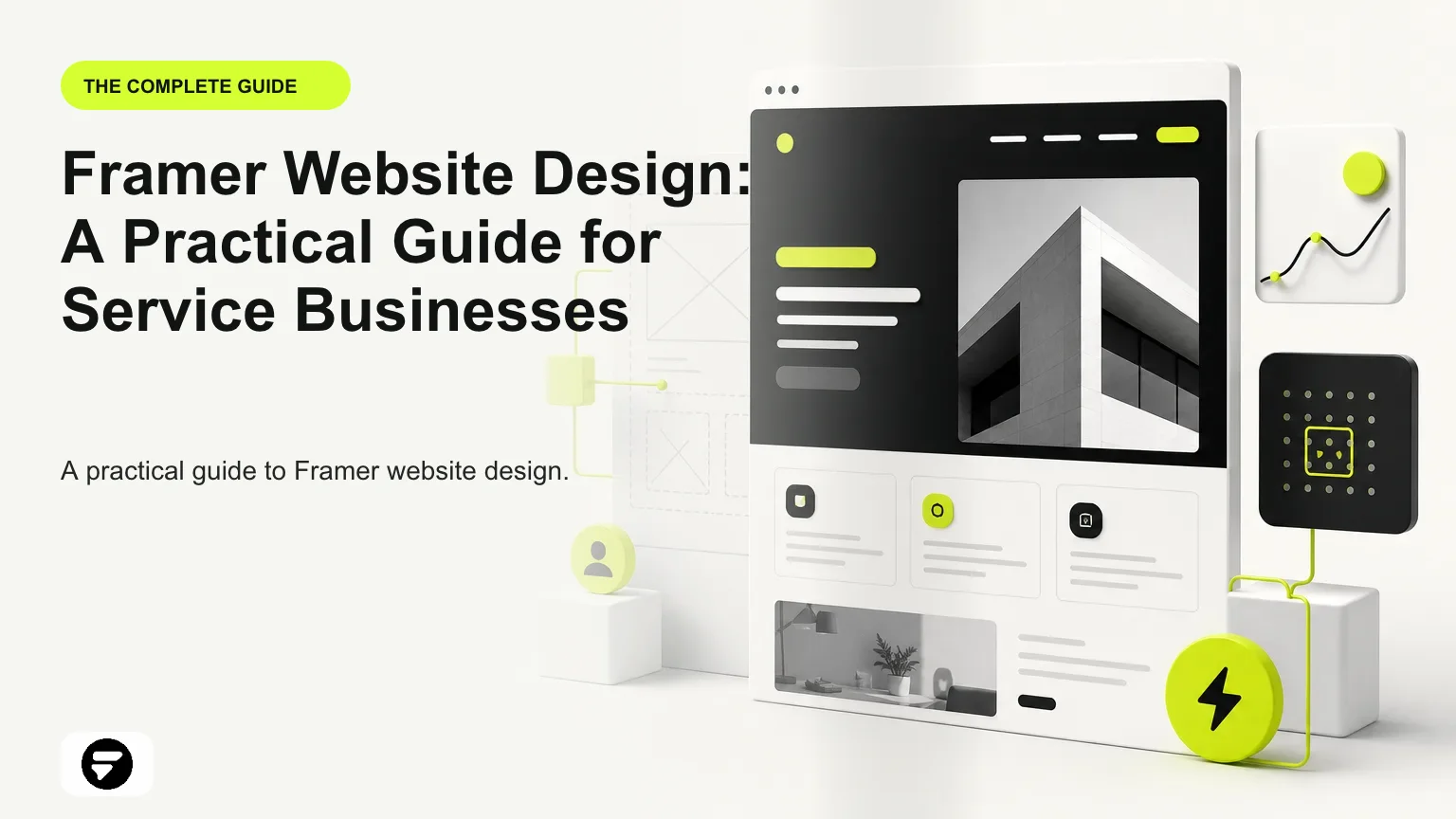

Framer is particularly well suited to modern marketing and service-business websites.
Start with positioning, content, and conversion paths before detailed visual design.
Build reusable components and intentional responsive layouts.
Define CMS fields around the publishing workflow.
Treat SEO, accessibility, analytics, and performance as project requirements.
Choose another platform when the website requires complex commerce or backend functionality.
Framer website design combines visual layout, responsive development, content management, and publishing in one platform. That can make it a strong choice for service businesses that need a modern marketing website without a large plugin stack or complex backend.
The platform alone does not produce a high-performing site. Strategy, messaging, architecture, accessibility, SEO, and conversion design still determine whether the finished website supports growth.
What Is Framer Website Design?
Framer is a visual website platform that supports design, responsive layouts, components, CMS content, hosting, publishing, SEO controls, and integrations.
Framer states that its CMS agent can set up and update the CMS while connecting it to the canvas so content and design remain synchronized. Source: Framer. For a business buyer, the more important question is not which feature exists, but how the website will be structured and maintained.
A complete Framer website project can include:
discovery and website strategy;
sitemap and content planning;
wireframes;
visual design system;
responsive development;
CMS collections;
forms and integrations;
technical and on-page SEO setup;
quality assurance;
launch and team handoff.
Is Framer a Good Fit for Your Website?
Requirement | Framer fit | Caveat |
|---|---|---|
Service-business marketing site | Strong | Content strategy is still required |
SaaS marketing site | Strong | Product app usually remains separate |
Blog and case studies | Strong | Plan collections and taxonomy carefully |
Portfolio | Strong | Optimize images and avoid excessive effects |
Large editorial publication | Evaluate | Workflow and scale may favor another CMS |
Complex ecommerce | Limited | Dedicated commerce platforms may fit better |
Membership or custom application | Evaluate | May require external systems or another stack |
Rapid landing-page publishing | Strong | Maintain design and content governance |
Choose the platform after defining requirements. Do not force a complex application into a marketing-site tool because the visual editor is appealing.
Start With the Conversion System
A service-business page should answer five questions:
What do you provide?
Who is it for?
Why should the visitor trust you?
What relevant proof is available?
What should the visitor do next?
For example, a service page can follow this structure:
clear outcome-led heading;
concise explanation of fit;
problems or situations addressed;
service scope and process;
relevant proof;
objections and FAQs;
primary call to action.
This does not mean every page should use the same rigid template. It means visual design should support decision-making. Our article on intentional web design for service businesses explores that principle further.
Build a Reusable Design System
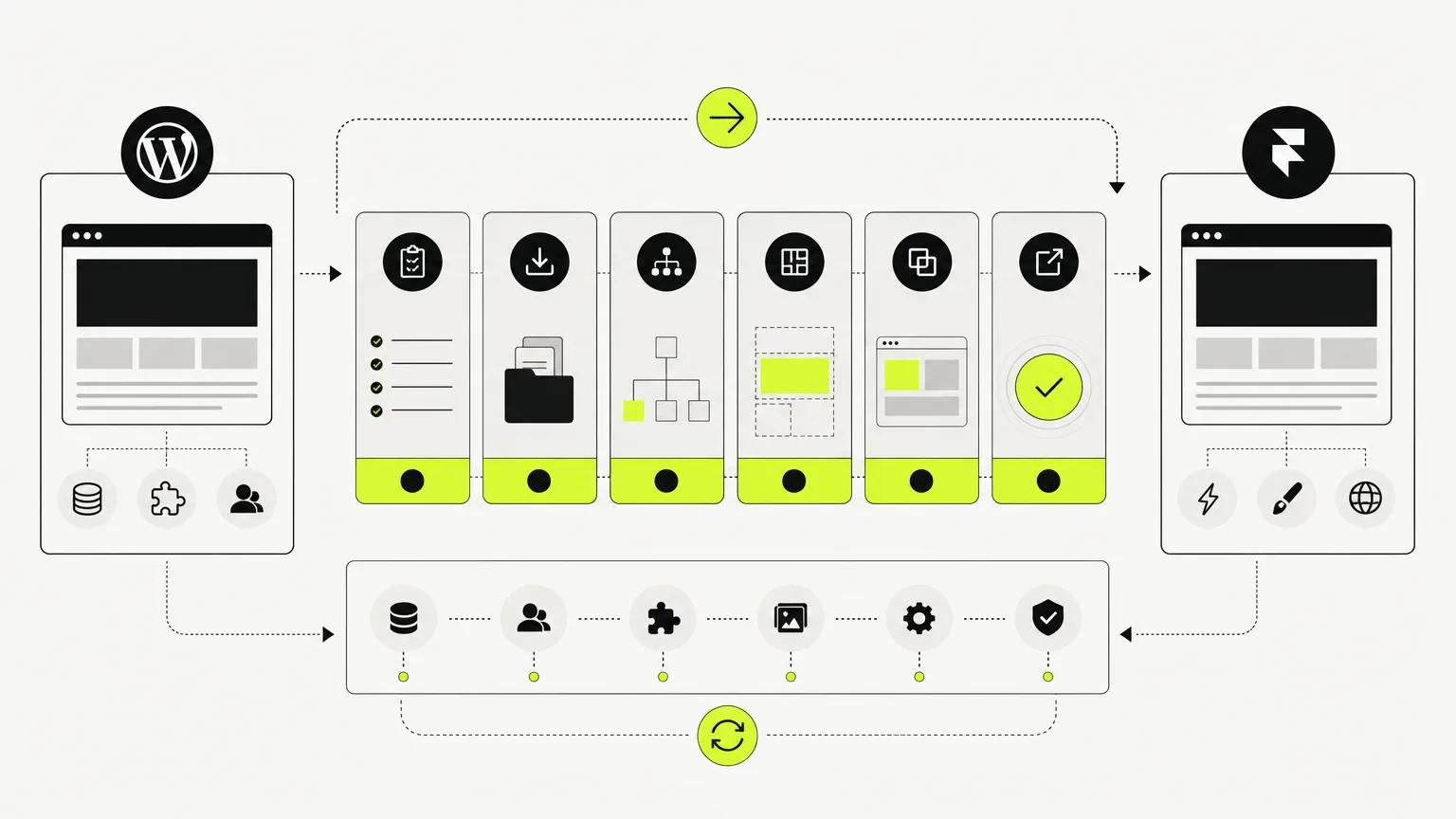
An informative diagram illustrating the process of migrating a website from WordPress to Framer, highlighting key steps and considerations.
A Framer design system should define:
color and contrast rules;
typography styles;
spacing conventions;
buttons and text links;
cards and content blocks;
form fields and states;
navigation and footer behavior;
image ratios;
responsive variants;
motion principles.
Reusable components improve consistency and reduce the chance that new pages drift away from the original design. They also make later optimization faster.
Design Responsive Layouts Intentionally
Responsive design is not simply shrinking the desktop layout. Review each breakpoint for:
heading length and wrapping;
navigation behavior;
button size and spacing;
image cropping;
card stacking;
table readability;
form completion;
sticky elements;
interaction and animation behavior.
Service-business traffic is often heavily influenced by mobile search and local intent. Calls, scheduling, and forms must work cleanly on smaller screens.
Plan the CMS Around Real Editing Tasks
Create CMS collections when content is repeatable and likely to grow. Examples include:
articles;
case studies;
services;
locations;
team profiles;
resources;
podcast episodes.
For each collection, define required fields, optional fields, URL behavior, related content, image guidance, metadata, and publishing responsibility.
Avoid creating a collection simply because the platform supports one. A CMS should reduce editing effort and improve consistency.
Framer SEO Foundations
A strong Framer build should address:
descriptive page titles and meta descriptions;
clear headings and semantic structure;
clean, stable URLs;
canonical settings;
redirects for changed URLs;
image optimization and alt text;
internal links;
crawlable page content;
sitemap and indexability checks;
mobile performance;
analytics and Search Console verification.
These controls create a foundation. Rankings also depend on useful content, competition, authority, relevance, and ongoing improvement.
A Practical Framer Design Process
Discovery
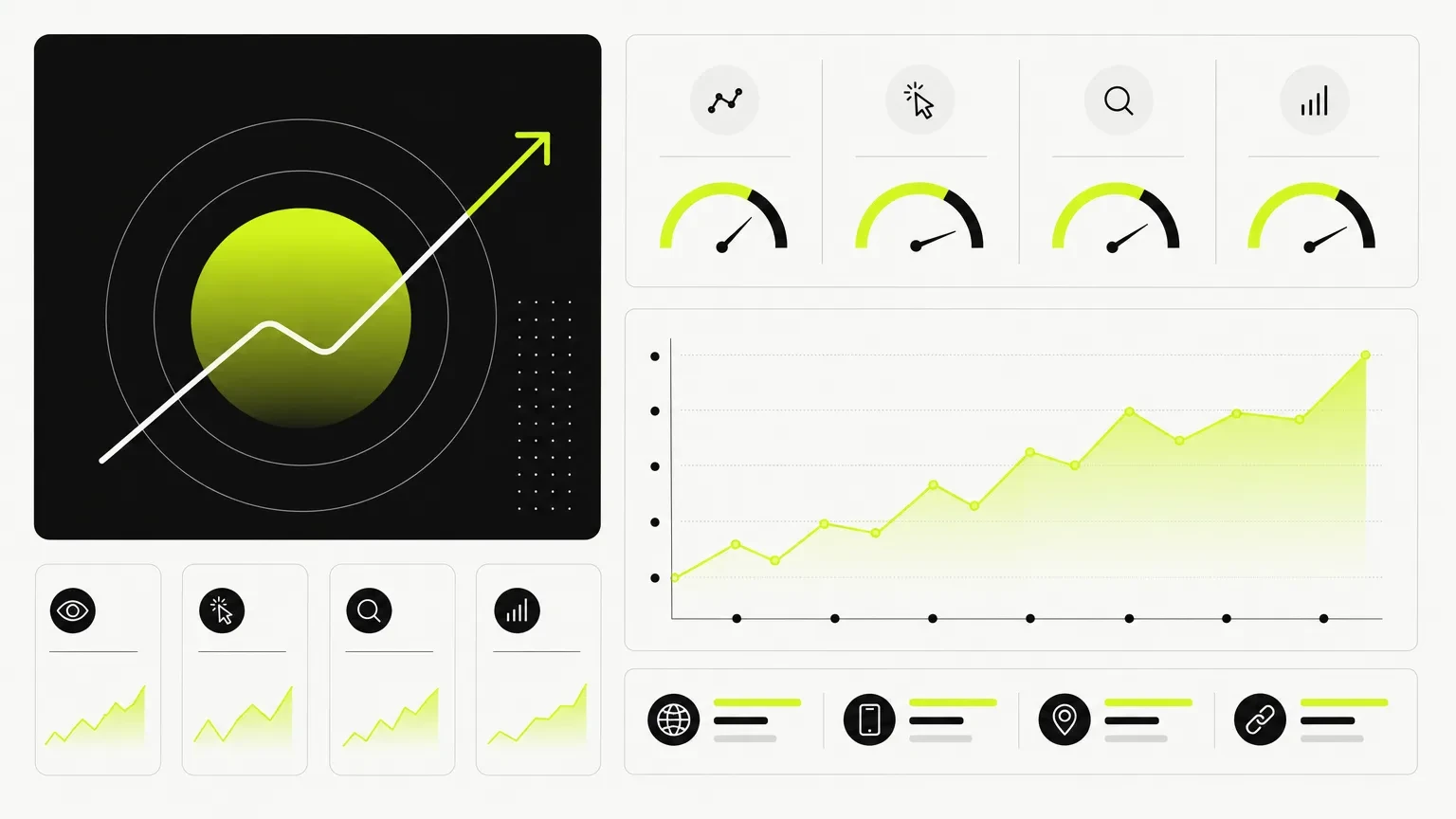
Visual representation of SEO performance metrics showing the effectiveness of Framer for website optimization.
Clarify the audience, offer, website goals, proof, technical requirements, and editing workflow.
Architecture
Create the sitemap, navigation, page purposes, content requirements, and conversion paths.
Wireframes and copy
Resolve hierarchy and messaging before investing heavily in visual polish.
Visual design
Create a scalable system and apply it to representative pages and responsive states.
Development
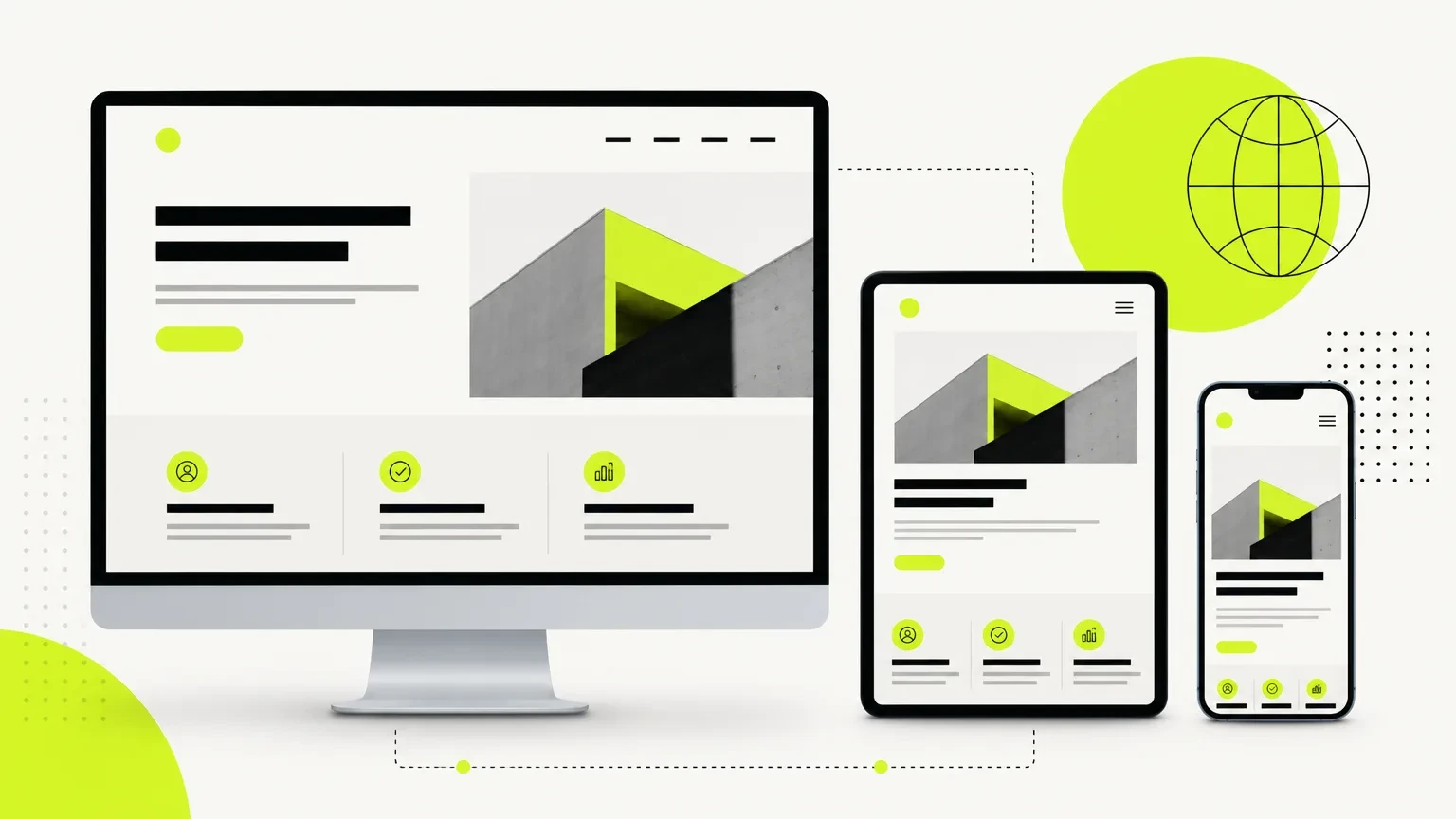
Illustration representing how a Framer website adapts seamlessly across various device sizes, ensuring optimal user experience.
Build reusable components, CMS structures, forms, interactions, metadata, and integrations.
Quality assurance
Test links, forms, responsive behavior, accessibility basics, performance, metadata, analytics, and redirects.
Launch and iteration
Monitor indexing and conversions, then use real user and search data to prioritize improvements.
We provide this connected process through our Framer website design agency. If your strategy and designs are complete, our Framer development service may be the more appropriate scope.
What Changes the Cost?
The main variables are page count, content strategy, copywriting, custom design, CMS complexity, integrations, migration risk, animations, stakeholder approvals, and post-launch support.
A template-based brochure site and a custom, SEO-sensitive redesign are different projects even if both contain the same number of pages.
Conclusion
Framer can provide an excellent foundation for a fast, modern, maintainable service-business website. The strongest results come from treating it as part of a complete website system rather than a visual shortcut.
Use the fit table, define the conversion paths, plan the CMS, and require responsive, SEO, and QA deliverables. If Framer matches your requirements, we can help turn the strategy into a complete design and development project.