Affordable should mean correctly scoped, not simply cheap.
Page count, content, custom functionality, migration risk, and approval complexity are major cost drivers.
A focused redesign of high-value pages may produce more value than rebuilding every page at once.
Every proposal should state what happens to URLs, metadata, forms, analytics, and mobile layouts.
Preserve useful content and rankings rather than treating the existing site as disposable.
Compare providers by deliverables, responsibilities, and risk management, not only price.
Affordable website redesign services should reduce unnecessary scope, not remove the work that makes a website useful.
For a service business, the right redesign should make the company easier to understand, trust, find, and contact. A low quote can become expensive if the project overlooks mobile usability, redirects, analytics, forms, service-page structure, or the content needed to attract qualified enquiries.
This guide explains how to control redesign costs while protecting the parts of your website that influence leads and organic visibility.
What Does an Affordable Website Redesign Actually Mean?
An affordable redesign achieves the required business outcome without paying for unnecessary complexity.
That definition changes by business. A five-page consultant website does not need the same system as a multi-location contractor with dozens of service-area pages. Conversely, a template swap is not an adequate redesign if the existing site has weak messaging, confusing navigation, or valuable pages that must retain their rankings.
A cost-effective scope typically prioritizes:
Clear positioning and service messaging
High-intent service pages
Mobile navigation and contact actions
Trust signals such as reviews, credentials, and project evidence
Fast, accessible page layouts
Search-friendly page structure and metadata
Reliable forms, tracking, and launch checks
Visual polish matters, but it should support these priorities.
What Changes the Price of a Website Redesign?
Cost factor | Lower-cost situation | Higher-cost situation | How to control it |
|---|---|---|---|
Page count | Five to ten core pages | Dozens of unique pages | Group pages by template and business value |
Content | Existing copy needs light editing | Positioning and copy need a complete rewrite | Approve messaging before visual design begins |
Design | Reusable component system | Many one-off layouts and interactions | Use a small, consistent design system |
CMS | Simple blog or project collection | Several related collections and workflows | Inventory content before choosing the setup |
SEO | Few indexed URLs | Established rankings and backlinks | Create a URL map and redirect plan early |
Integrations | Standard contact form | CRM, scheduling, calculators, or automation | Separate essential launch features from later enhancements |
Stakeholders | One decision-maker | Several approval layers | Assign one final approver and fixed review rounds |
For a deeper pricing breakdown, read Website Redesign Cost in 2026.
Three Ways to Make a Redesign More Affordable
1. Redesign the pages closest to revenue first
Start with the homepage, primary service pages, contact page, and any location or industry pages that already attract qualified visitors. Supporting articles and low-traffic pages can follow after the main conversion path works.
A useful priority formula is:
Priority = commercial importance + current traffic + severity of the problem + implementation urgency
A high-traffic service page with an unclear offer should usually come before an old blog post with no impressions or enquiries.
2. Build a reusable page system
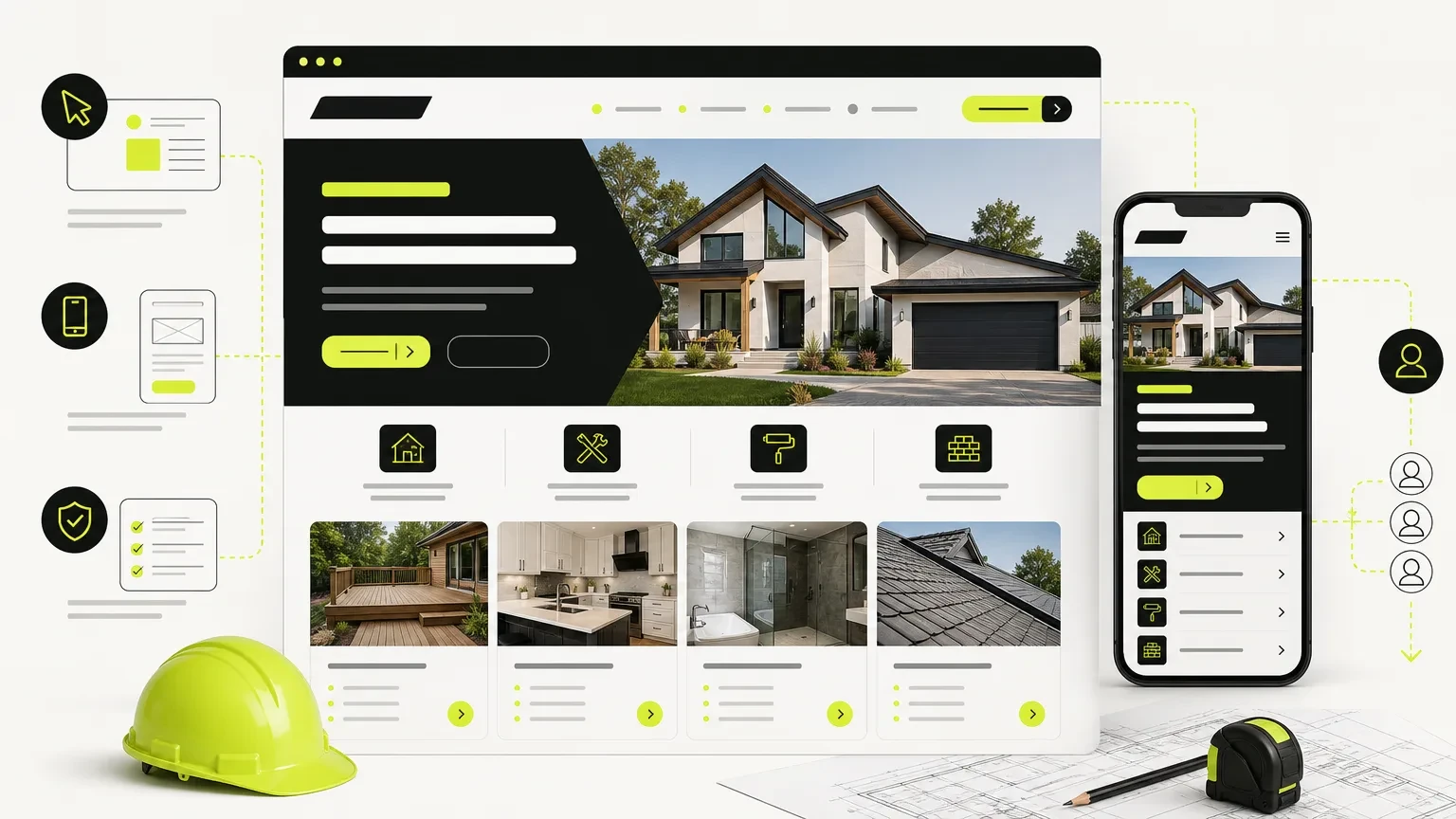
Example of a website redesign for contractors emphasizing user engagement.
A coherent system lowers both initial and ongoing costs. Service pages can share a structure while retaining unique copy, evidence, and FAQs. Project pages can use one CMS template. Calls to action, testimonials, and process sections can become reusable components.
This is different from making every page identical. The goal is to reuse the underlying system while adapting the information to the visitor’s intent.
3. Divide launch requirements from growth work
Not every idea needs to be included in version one.
Launch requirements might include:
Core page design and development
Responsive layouts
Forms and scheduling links
Essential CMS collections
Metadata and redirects
Analytics and Search Console verification
Cross-device quality assurance
Later growth work might include:
Additional industry pages
New case studies
Conversion experiments
Content production
CRM automation
New landing pages
A phased plan can make a high-quality redesign financially manageable without compromising its foundation.
Minimum Viable Redesign Scope for a Service Business
A credible redesign proposal should cover more than a new visual theme.
Strategy and structure
Business goals and primary conversion action
Intended audiences
Sitemap and navigation
Page-level purpose
Content responsibilities
Design and development
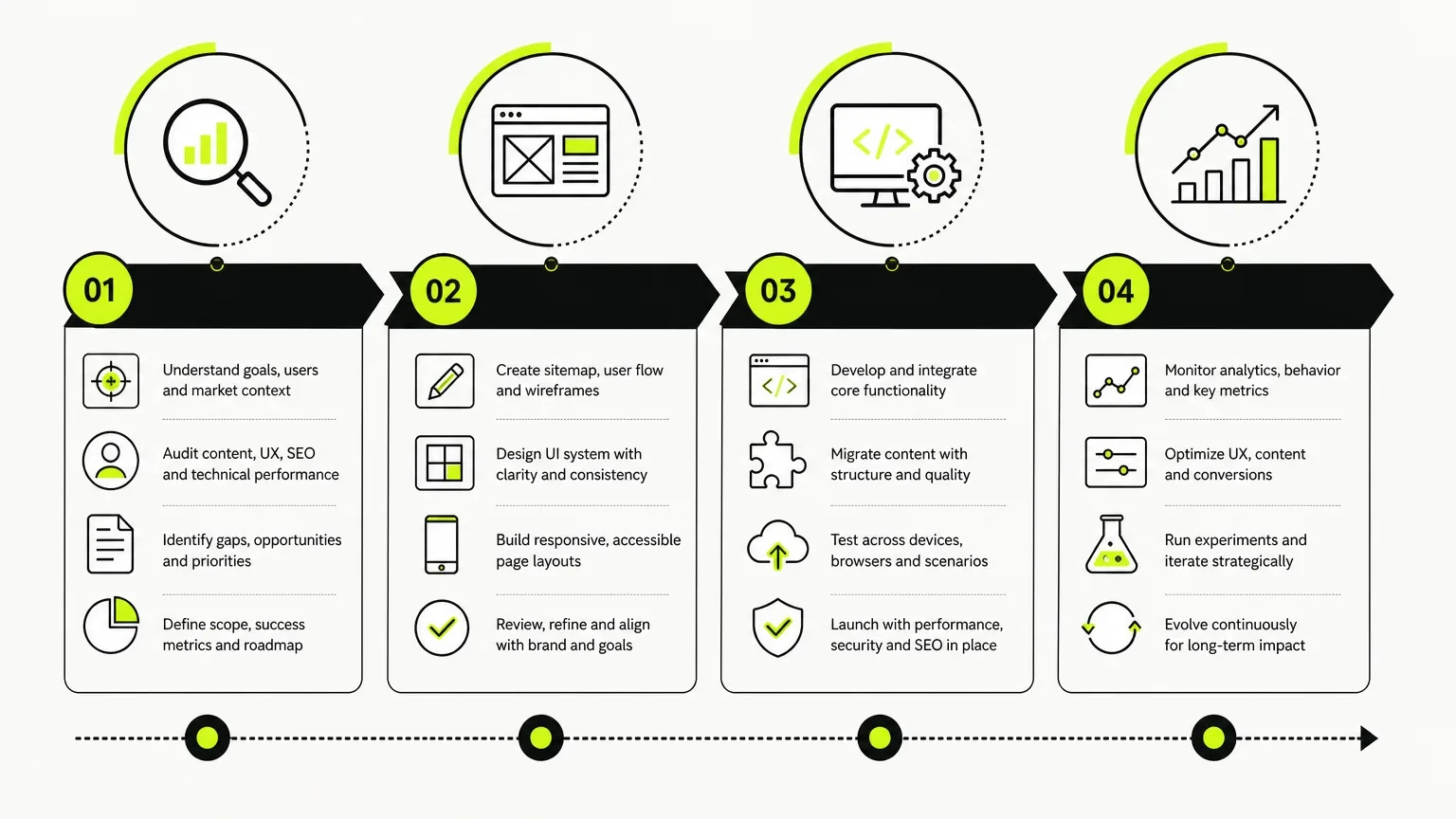
Visual guide explaining the phases involved in a website redesign.
Desktop and mobile layouts
Reusable components
Accessible typography and contrast
CMS requirements
Form behavior and confirmation states
SEO protection
Existing URL inventory
Redirect map for changed URLs
Titles and descriptions
Heading hierarchy
Image alt text
Sitemap and indexing checks
Internal-link review
Launch and measurement
Analytics installation or preservation
Search Console verification
Form testing
Broken-link testing
Mobile and browser checks
Post-launch monitoring
If several of these items are absent, ask whether they are excluded, assumed, or billed separately.
Affordable, Cheap, and Phased: What Is the Difference?
Approach | Best for | Main benefit | Main risk |
|---|---|---|---|
Cheap template replacement | A temporary site with little existing value | Low initial price | Generic messaging and missing SEO safeguards |
Focused redesign | An established business with a limited set of valuable pages | Concentrates budget on revenue-critical journeys | Requires disciplined prioritization |
Phased redesign | A growing site with more work than the current budget allows | Protects quality while spreading investment | Needs a documented roadmap |
Full strategic redesign | A site with broad structural, brand, content, and technical problems | Solves connected problems together | Higher initial investment |
The lowest quote may exclude content, migration, technical SEO, or post-launch support. Those exclusions do not make the work disappear. They shift it to the client or create future repair costs.
Our article on the hidden costs of low-cost web design explains where those costs often surface.
How to Compare Website Redesign Providers
Score each provider from 0 to 2 for every criterion:
0: not addressed
1: mentioned but unclear
2: clearly included with ownership and deliverables
Criterion | Questions to answer |
|---|---|
Business strategy | Do they connect page decisions to leads, sales, or another defined outcome? |
Scope clarity | Are included pages, templates, revisions, and integrations listed? |
Content | Who writes, edits, approves, and uploads it? |
Mobile experience | Are mobile layouts deliberately designed and tested? |
SEO migration | Who maps URLs, creates redirects, and checks indexing? |
Measurement | Will analytics and conversion events work after launch? |
Ownership | Who owns the domain, content, design files, and platform account? |
Support | What happens after launch, and for how long? |
A lower-priced provider can still be the right choice if the scope is transparent and matches your needs. The warning sign is not a low price by itself. It is a low price paired with undefined responsibilities.
Red Flags in an Affordable Redesign Proposal

Comparison of SEO performance between strategic redesigns and budget rebuilds.
Be cautious when a provider:
Recommends a platform before reviewing requirements
Promises rankings without evaluating the site or market
Cannot explain how existing URLs will be handled
Uses unlimited revisions as a substitute for a clear process
Excludes mobile testing or treats it as automatic
Provides no content plan
Cannot identify what will be measured after launch
Requires the provider to retain ownership of essential accounts
Quotes a price without confirming page count or functionality
A Sample Cost-Conscious Redesign Plan
Consider an established contractor with an outdated 25-page website. The budget does not support rewriting and redesigning every page immediately.
A sensible first phase could include:
Audit all URLs, traffic, backlinks, and conversions.
Redesign the homepage, contact page, and four highest-value service pages.
Create reusable service and project templates.
Preserve useful supporting pages in the initial migration.
Add redirects only where consolidation is justified.
Publish new projects and location pages in later phases using the approved system.
This approach does not pretend the lower-priority work is unnecessary. It sequences the work according to business impact.
What to Prepare Before Requesting Quotes
Send each provider the same information:
Current website URL
Primary services and geographic market
Most valuable enquiry type
Known problems with the current site
Required pages and integrations
Examples of useful existing content
Brand assets that can be retained
Desired launch window
Approximate budget range
Internal decision-makers
Need for ongoing content, SEO, or optimization
Comparable briefs produce more comparable proposals.
When Ongoing Optimization Is Better Than Another Rebuild
A redesign creates a stronger foundation, but it should not become a cycle of complete rebuilds every few years. If the platform and structure remain healthy, ongoing improvements may be more economical.
That can include publishing service content, improving weak pages, adding project evidence, reviewing search performance, and testing conversion paths. Frummerin Digital’s website redesign and ongoing growth approach is designed around making the website a maintained business system rather than a one-time visual project.
Conclusion
The best affordable website redesign services do not win by removing strategy, SEO, or quality assurance. They control cost through prioritization, reusable systems, clear responsibilities, and phased implementation.
Before choosing a provider, define the outcome, compare the actual deliverables, and identify which risks remain with you. A focused redesign that preserves visibility and supports qualified enquiries is usually more affordable than buying a weak website and replacing it again.